
Stew! Part 2
Contemplation & alienation

April: Alchemy
I began writing this months ago now, when I was still at my old hospitality job. A crisp immortalisation of the little scraps of peace I had found there, working with my body, and often against it. At the time I had an idea of what I wanted to write for the rest, and I had an idea that it would come out easily, quickly.
Instead, I let it stew.
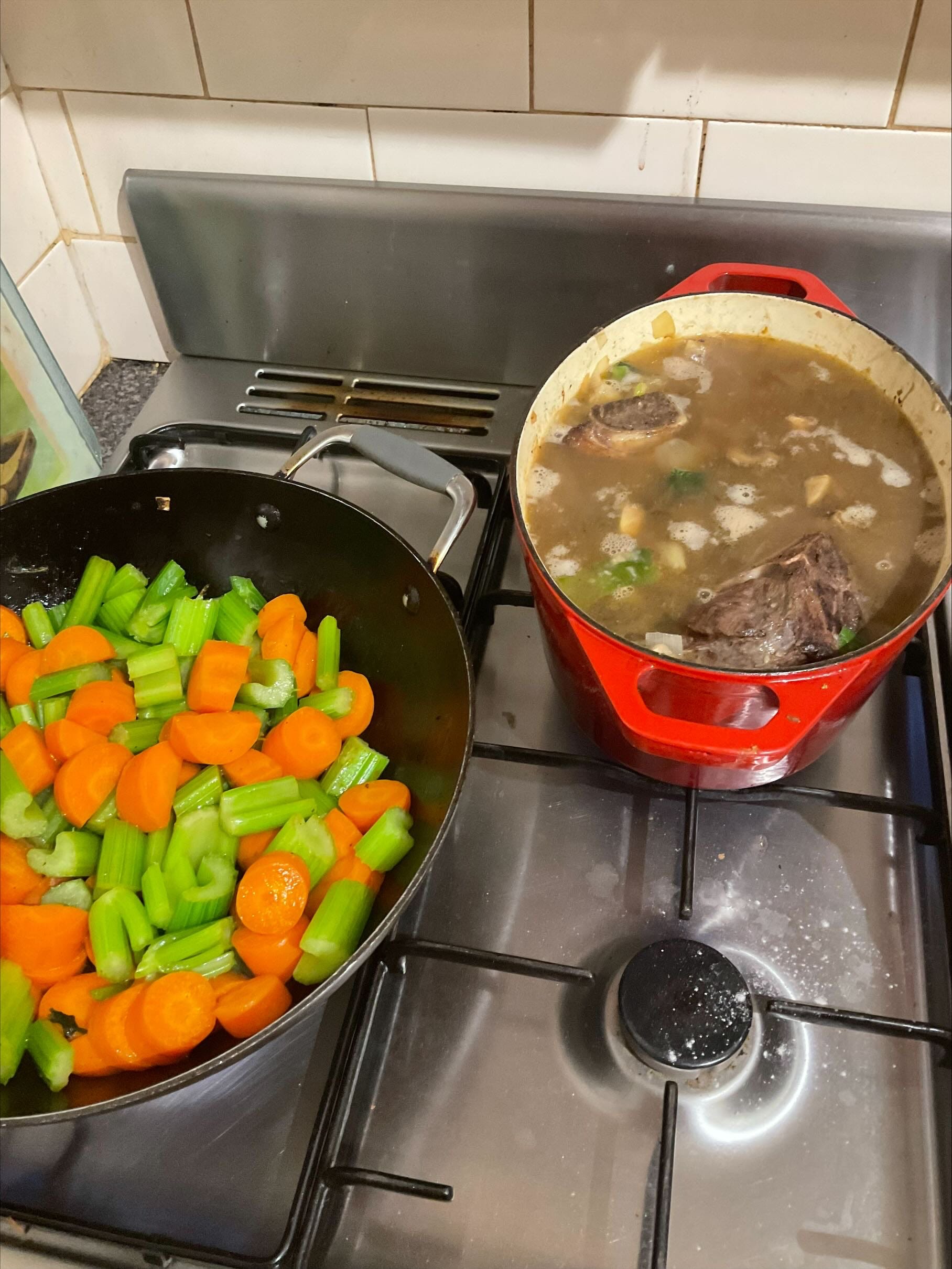
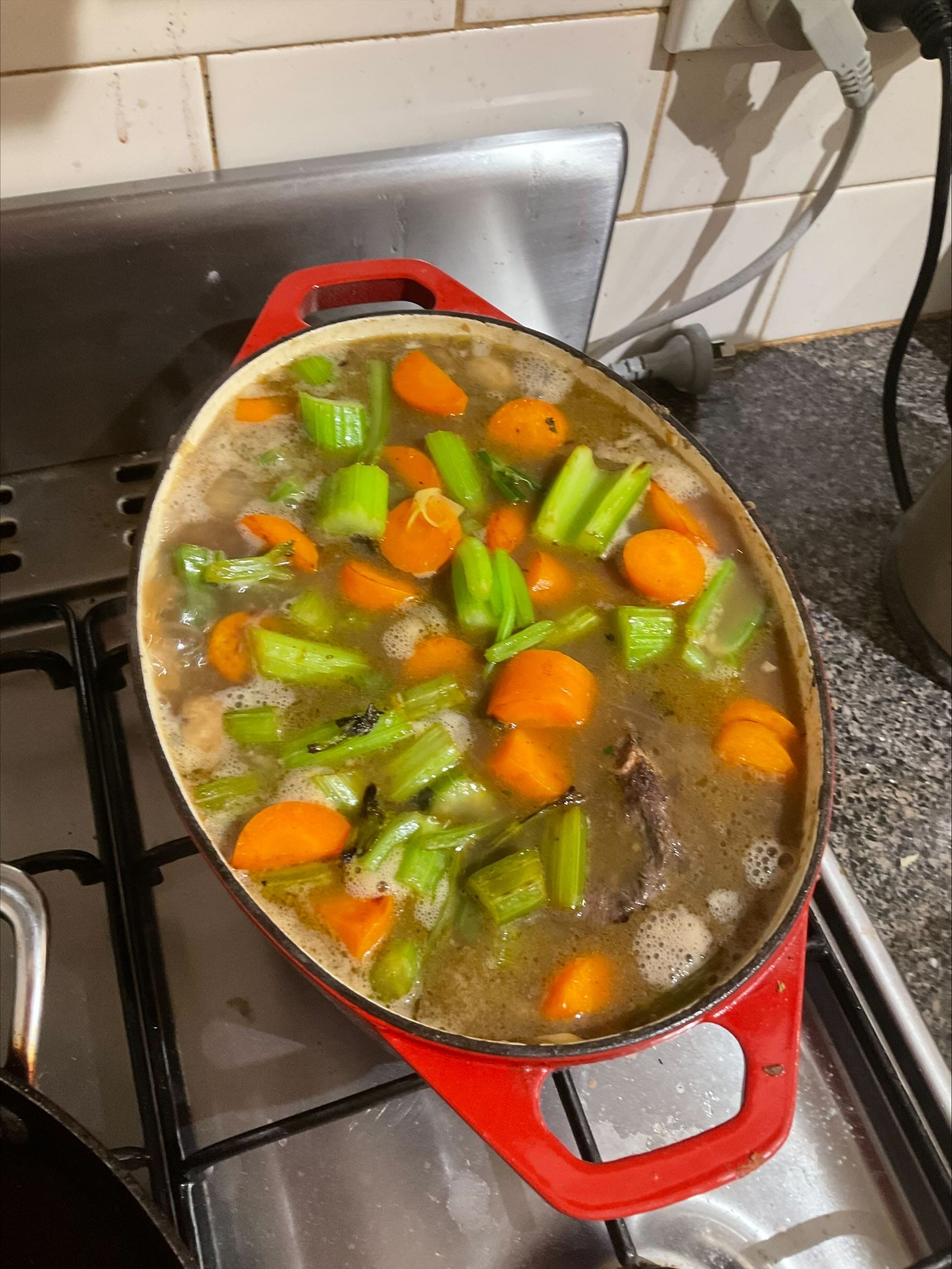
The essence of a good stew is a ((slow)) emulsification of disparate elements into a homogenous dish, without sacrificing depth of flavour. Ingredients that would constitute a "complete" meal in their own right (the meat, caramelised vegetables, wine, broth, whatnot) enter a unique relationship, and something new is forged out of seemingly opposing forces. Oil and water; sweet and saline; solid and liquid. All are brought into harmony with the help of only gentle heat and patience.
By my third attempt at writing this, it became obvious that I was not allowing it the necessary time and attention to bring together the internal oppositions. On the one hand, I wanted to explore the lessons I had learnt in the kitchen about sitting with my thoughts and feelings without drowning in them. On the other, I couldn't stop finding myself reflecting on the alienated nature of this labour. Less alienated maybe than other fields I have worked in, but still, a clear line cut through the time I was paid for and the profits derived from my labour. I couldn’t discuss contemplation without addressing alienation.

i. Labour
One of the key markers of the capitalist economic system is that labour-productivity is measured in time. In order for profit to be made, the output must be greater than the cost of labour, and labour is measured by the hour. There is thus a foundational disconnect between the concrete time needed to produce a commodity, and the abstract hours that are actually paid. The more pride a labourer takes in their work, the harder it is to conform to the artificial time limits of capitalist production; the more the worker produces in an hour, the more exploited their labour. As Marx put it, rather poetically, “Time is everything, man is nothing.”
However, in order for this economic system to function, the time required to produce a commodity must be both quantifiable and predictable. Labour must therefore be reduced into its constituent parts — stripped of all potential variation by human interference or chance. Because of the emphasis on standardisation of production within the capitalist economic system, any room for both error and innovation by the individual labourer is elided, setting a limit on the human creative capacity.
While the economic system continually self-revolutionises, the humans within it are reduced to predictable producers. All work is measured in the same way: quantitatively. Labour is thus transformed from a social relation into an abstract, rational operation; it is made into a thing. This is the process Hungarian Marxist-revolutionary Georg Lukács refers to as reification, wherein “a relation between people takes on the character of a thing.”
This phenomenon permeates beyond the confines of the work day, ultimately rendering the current system the appearance of immutability.
ii. Reification
In Reification and the Consciousness of the Proletariat, Lukács outlines the twofold effects of reification: On an objective level, the world is narrowed down into an economic relation between objects, of which the individual’s own labour is considered to be a tradable ‘thing’. On the subjective level, however, as labour-power is increasingly understood to be a commodity in the eyes of labourers themselves, workers become more and more alienated from their own activity — including their capacity for thought. In the words of Lukács: the worker’s “qualities and abilities are no longer an organic part of his personality, they are things which he can ‘own’ or ‘dispose of’ like the various objects of the external world.”
Lukács uses the example of the traditional artisan who — though specialised just like the worker in a capitalist system — has a phenomenological experience of creative growth that the factory line worker, for example, does not. Where the artisan gains some sense of having undergone an inner transformation through the act of creation — growing in their skills potentially infinitely, the line worker doesn't have this privilege. In every way, and pervading every facet of life, the worker is reduced to a “mechanical part” in a “mechanical system” to which they must conform, their will to act diminished by the day...
Even the ‘creative’ work of generating ideas is rationalised and mechanised to the maximum extent possible, such that the cognitive processes of the worker come to be regarded as mere tools, separated from the worker's own sense of subjectivity. This alienation of the self from itself, the mind from the mind, is what Lukács terms the “contemplative stance” — in which there ceases to be “any qualitative difference in the structure of consciousness” between forms of labour. Creativity no longer correlates with the nature work itself, but rather with the nature of the relationship that the worker experiences with “the machine he serves and observes.”
Reification erodes our capacity to think beyond capitalism, to think of ourselves as subjects as opposed to amalgamations of commodities. But, as soon as we understand this process — how it operates, and how it can be disrupted — then we can begin the real work of revolution.
iii. Dialectic
Marx was very clear that people have a practical role to play in history. In his theses on Feuerbach, against the “contemplative” materialists of his time — who viewed people solely as “products of circumstances and upbringing” — Marx argued for the active role of subjectivity. Reality cannot, for Marx, be reduced to the “form of the object” or a passive contemplation of it; reality is an ongoing process, as is history.
‘Contemplation’ here takes on a pejorative sense, wherein it implies a retreat from action; whether through the sense of futility of the non-dialectical, wholly deterministic materialism of Feuerbach, or what Marx considered an artificial sating of the need for better material conditions in the idealism of Hegel and his predecessors. Against this, Marx stresses the capacity of people to change their own circumstances and affect their own reality.
This change is achieved, however, not by the individual — but by the collective. The world, for Marx, is fundamentally conceptualised as a relationship between social beings. Reification and alienation obscures this relation, reducing us to individuals situated against an immense, impenetrable, imperishable ‘system’, when in reality we are active constituents of the class relation.
Lukács’ taking from this was that the key to revolutionary thinking is to approach class as a dialectical totality. Meaning, we ought to ‘think class’ not in terms of individuals either profiting off or being exploited by a ‘system’, but as a category that cannot exist without its opposite; there can be no object without subject, no night without day, no working class without the capitalist class. To quote Lukács once more, “When the dialectical method destroys the fiction of the immortality of categories, it also destroys their reified character, and clears the way to a knowledge of reality.”
When we approach class dialectically — as two parts of a whole, which cannot exist without each other — it becomes clear that to abolish one would result in the dissolution of the other. Rather than launching complaints against an abstracted and immortalised ‘system’, the dialectical method illuminates a practical path to revolution that uses the foundations of capitalism against itself.
Notes I took on stewing:
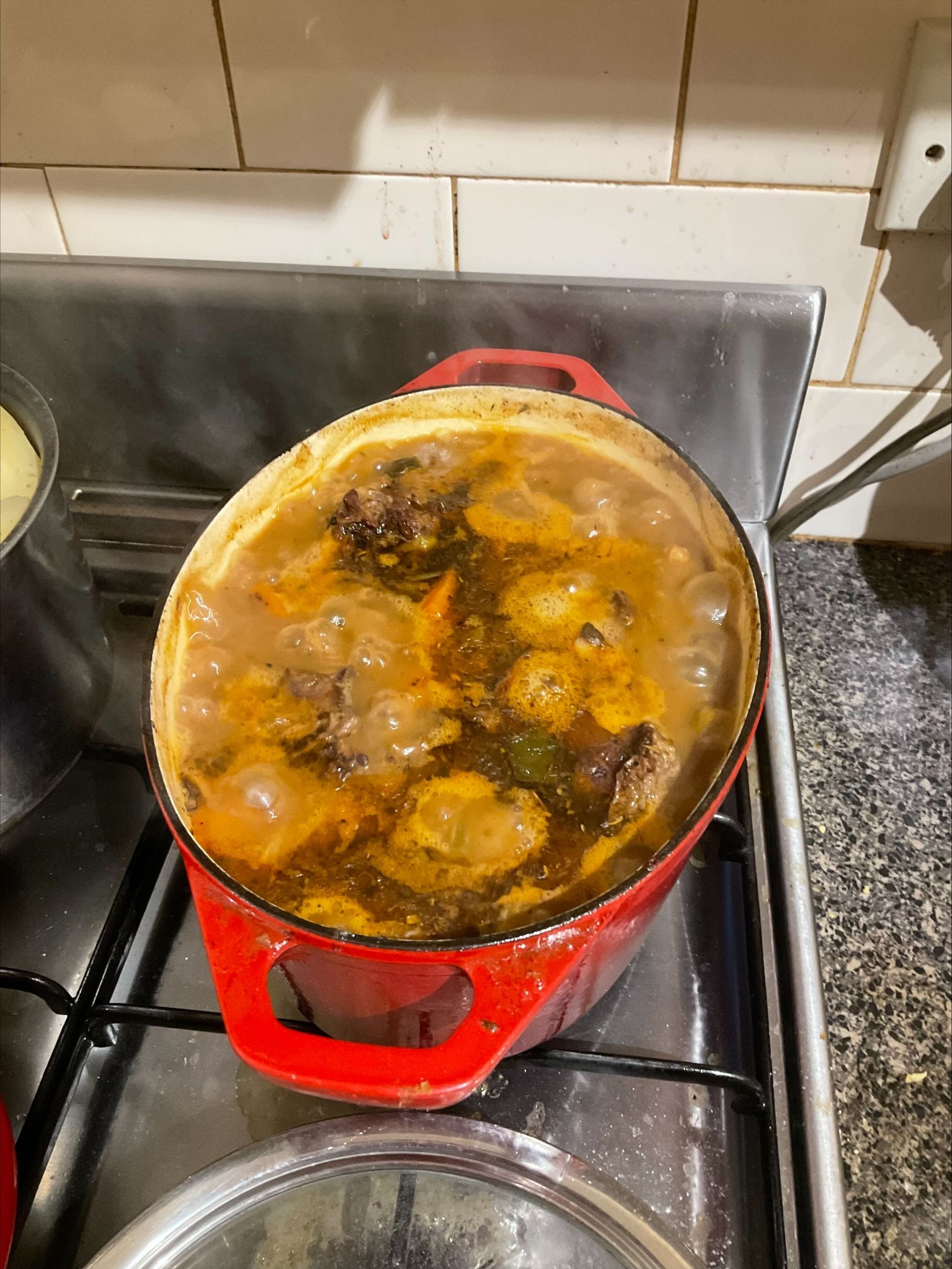
Browning the meat caramelises the surface, which adds colour, texture, and traps in flavour and nutrients.
Similarly, frying vegetables before adding them to the stew enriches the flavours, removing any bitterness.
Aside from the richness of a fermented taste, alcohol helps fat soluble ingredients to integrate into the dish.
Because slow cooking is done at a lower heat, in a closed container, more of the nutrients are retained, while any lingering bacteria is killed. Meat becomes tender without loss of flavour.
June: Prayer
Hospo took a lot from me, but it gave me one thing: time to think. Lots of it.
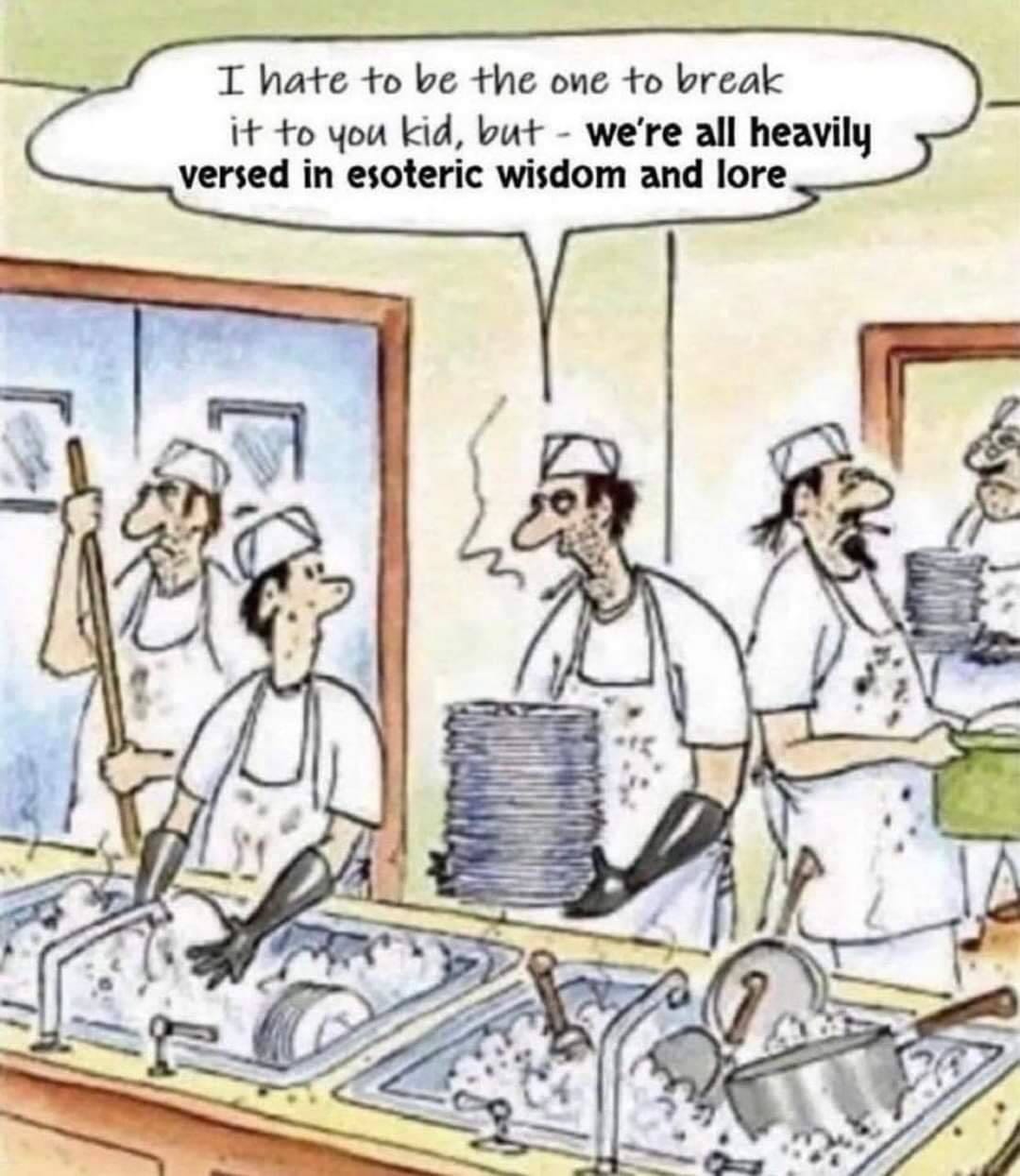
All the hours I spent endlessly slicing, frying, grilling, assembling while working in hospitality made me the most tolerant of tedium I have ever been. The inconsistency of the hours coupled with the often repetitive, high stress content of the work called attention to each passing second. The burden of boredom was lifted only a little by the task at hand, and time thickened in the knowledge that my hours were bought. There was no way out. I had no choice but to wade on through, to make the grueling passage from clock-in to clock-out.
But there was something calming about this repetition, something real underneath it all. Cooking, cleaning, eating, sleeping; the cyclical and perpetual have no lasting product to which we can cling. There is no end goal except to keep living, to keep going. The benches and dishes and floors get dirty again. The food gets consumed, digested, expelled. The hunger returns. The work is always in the process of being done, the end never seen.
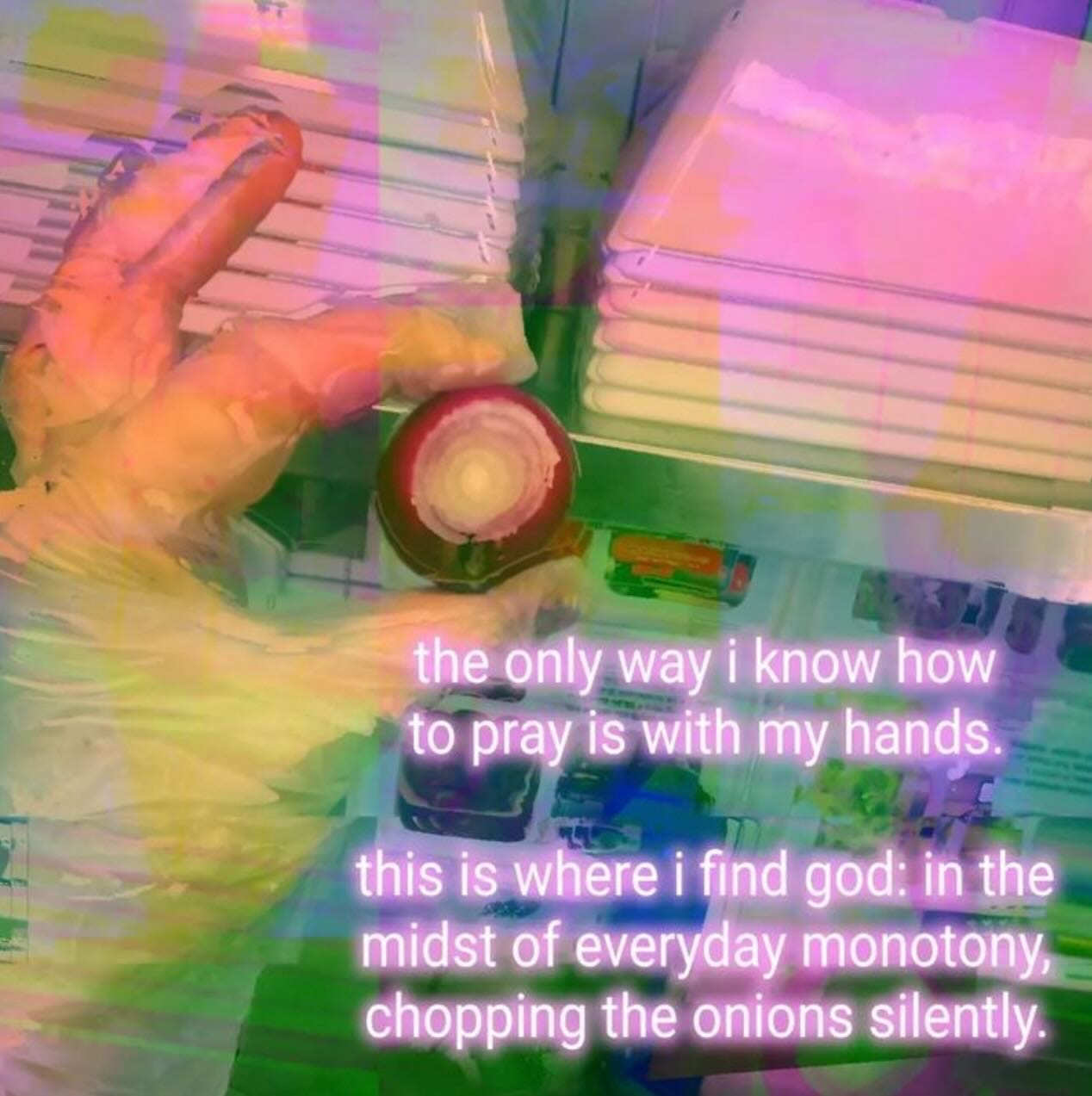
It was in the kitchen that I learned how to contemplate, with the help of my trusty copy of Plotinus's Enneads.
I was able to get through 2, maybe 3 pages of The Enneads on my half hour lunch break each day. A few more on the tram home. This slow, intermittent manner of approaching the text was a lesson in contemplation in itself. It required me to develop the ability to hold whatever I had read — in my little snatches of free time — in my mind for an hour, two, four. Then pick up where I'd left off. The work of contemplation bled out from the pages, permeating my work day, colouring my experience of the labour.
More than just consumption, contemplation requires the process of cognition to extend beyond the bounds of the initial action of reading and comprehending. It is ongoing, it is consuming. But it is also generative.
What stood out to me about Plotinus, what made his work so relevant to that time in my life, was the stress that he placed upon the concept of contemplation as an active process of creation. Plotinus says, “to bring anything into being is to produce an idea-Form and that again is to enrich the universe with contemplation.” This is a perspective that shifted quite fundamentally my relationship to working. Each time that I worked in the kitchen, I was putting what I had read into action.
The daily, repetitive action of creation was henceforth re-contextualised as an act of contemplation.
Before I go on, however, I must return to Lukács and Marx, and their usage of the concept of ‘contemplation’.
The pejorative usage of this term in the work of both Lukács and Marx shouldn't be taken as a mark against the act of mediating, or deeply thinking, or clearing the mind of thought, or any of these actions which we may associate with contemplation. What the term intends, rather, is to express the deep sense of powerlessness, and erosion of the Will caused by the rationalisation and mechanisation of labour. It alludes to a state of being in which words become no more than words, the action of people appears to originate from outside of themselves, and ‘human innovation’ is reduced to nothing more than another automatic system of production.
The Marxist position against the ‘contemplative stance’ is foundationally a commitment to the practical application of theory; it is a warning against both an attitude of defeat, and false contentment with an imperfect, able to be improved, reality. ‘Contemplation’ is thus situated as a metaphysical disposition, which can be contrasted with the active-force of dialectics.
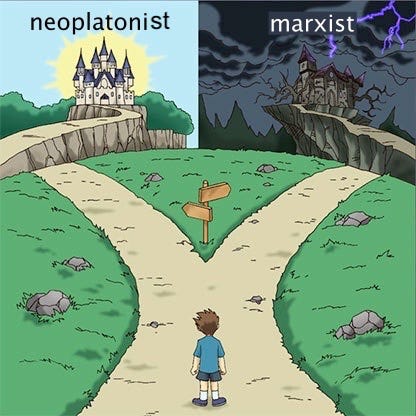
For Marxist thinkers, the problem with ‘metaphysics’ is that it fails to go beyond mere contemplation of its object, and thus does nothing to change the conditions of our existence. What's interesting to me about Plotinus is that his interpretation of Plato manages to flip this relation: rather than contemplation equaling to passivity, action is situated as the driving force of contemplation.
For Plotinus, and his predecessor in Plato, the world is conceptualised as a relationship between a contemplator, the object of their contemplation, and the unifying principle of contemplation itself, to which they strive. The ‘subject’ and ‘object’ are here made interchangeable; one may be at once the contemplator and the contemplated upon, and in the deeper stages of contemplation there ceases to be a distinction between them at all. Subject and object exist in dialectical unity, wherein one cannot find its existence without its other, each seeking the Intellectual-Principle in which they will be made one, “a complete identity of Knower and Known.”
In this view, we are compelled to create (and even just the act of living and growing is a manifestation of the creative capacity) not just for the sake of it, or for the sake of the thing we aim to create, but because creation allows us to deepen our relationship with that which is 'external' to us, such that the boundary of internal-and-external ceases to be. All action aims at contemplation; whether that be a drive to admire the finished product of creation, or, “more nobler,” to come into deeper relationship with some fundamental aspect of reality.
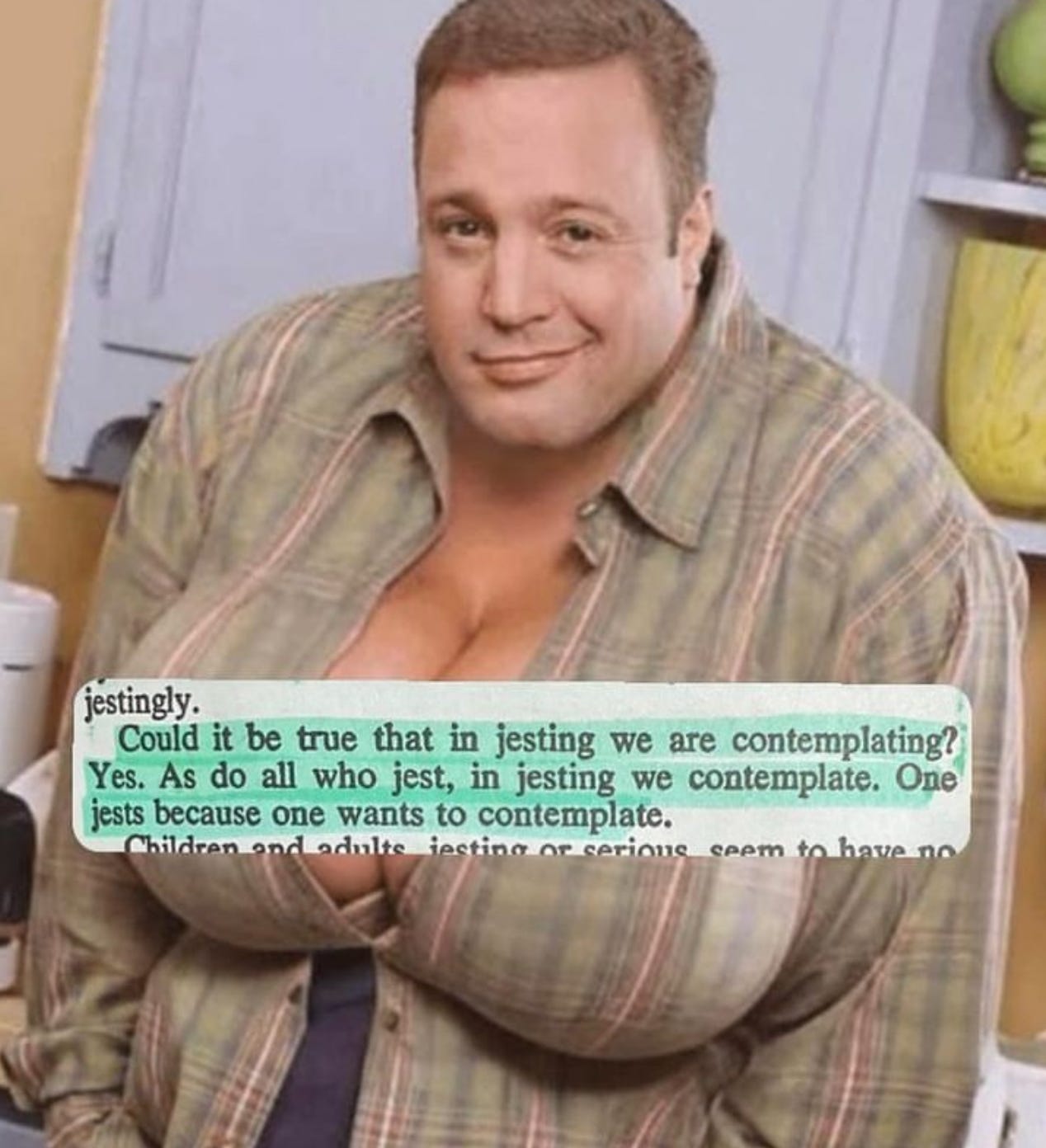
Contrary to modern bastardisations of meditative practice, as seen in secularised 'mindfulness’ and the popular CBT technique of ‘grounding’ - which encourage ‘presence’ in the moment, while obscuring the social and structural aspects of existence (such as labour conditions), and ‘acceptance’ of life as it is (and by extension, acceptance of our exploitation), the Neo-Platonic contemplative approach of Plotinus marries vision and action, change and contemplation. While the ability to face one’s thoughts and feelings is an important part of the practice, it is not the end goal but the entry-point for action and evolution.
The reason why I've been drawn to approaching Marxism via Lukács, and Platonism via Plotinus, is because I have found these latter writers to offer a uniquely practical perspective on the philosophies. Most notably, it immediately reveals their ((shared)) commitment to dialectical methodology, wherein all things exist only in relationship; a totality formed of the object and its opposite.
For the Platonists, the focal point of reality is the relationship between conscious subjects, whereas for the Marxists, focus is placed upon the relationship of classes (who are, arguably, not yet conscious…). In either case, the goal is change, and the means of achieving this change is through grasping the totality; apprehending the fundamental wholeness of being.
To approach contemplation dialectically is to open up the floor for metamorphosis. The only question left is what kind of world we are seeking to bring into existence.