
Stew! Part 1
Sitting with sacred time

![[meme] a hand holds an onion up, glitch filter over the image. text reads: all the wonders of the world cant come close to the fear of god invoked by chopping onions at 8am](https://substackcdn.com/image/fetch/$s_!Dqj_!,f_auto,q_auto:good,fl_progressive:steep/https%3A%2F%2Fsubstack-post-media.s3.amazonaws.com%2Fpublic%2Fimages%2F7d616056-3a1f-446b-8e0b-65d2e834b410_1271x1271.png "[meme] a hand holds an onion up, glitch filter over the image. text reads: all the wonders of the world cant come close to the fear of god invoked by chopping onions at 8am")
February: Theory
In the kitchen, every action is a prayer.
There is a precarious harmony to be found in the slow-cooked insanity of a menial and more or less meaningless task repeated over and over again.
The circular motion of the slicer is the same as the can-opener is the unscrewing of a bottle lid is the turning of a handle is the key in the register is my fingers running along the knotted length of a rosary in prayer. With time and attention, boredom creates ritual out of the repetition.
Working in the kitchen, the day passes in elastic stretches. It oscillates between blind scrambles that — while punishing — devour a good half hour, and a heavy, ticking calm that makes you want to stick a thumbtack through your own palm. This, of course, scattered with a quick cry in the break-room, a micro-nap prostrate on the filthy toilet floor, a concerning reliance on caffeine and over-the-counter painkillers, and other such staples of the industry...
There is a not insignificant part of me that has taken pleasure in the constant aching feet, aching knees, aching back, aching everything. Somehow it is a reassurance to do work I can feel resonating in my flesh. It feels real. Even when nothing else does.
But, in all the multitude horrors of the occupation, there is always some peace to be found in the shortness of the space between my work and the waiting customer. It's like a part of me is soon to be part of them. The fruit of my labour; absorbed and enjoyed by a stranger.
I have loved working in hospitality. And hated it. And loved it. And hated it, and hated it, and hated it, and loved it. And hated it.
It was working in hospitality that destroyed my health. And it was the quiet and boring mornings chopping vegetables which saved me.
I recently* left a restaurant I worked at for nearly two years. It almost definitely won't be the last hospitality job I take (actually I am already missing it, just a bit), but for now it is a needed break.
To honour my time spent in this horrifically fast-paced industry, I decided to make a slow, slow cooked stew.
March: Practice
First things first: I have never made stew before in my life.
Actually, I wasn’t certain I'd even eaten stew before. I had to google 'stew' and scroll through the images to get an idea of what it even is. Less for lack of knowledge and more because the distinction between stew and soup and even curry was a mystery to me. And yet... The urge to cook up a nice chunky stew had been, for some time, calling out to me. Even though it is currently* the tail end of (the climate-change-extended) summer in Australia. Not exactly stew weather.
I asked my grandmother if she had a recipe I could use and she handed me an aged cut-out from a magazine for a "Beef Provencale" — made with eggplant and zucchini, and a canned tomato and beef stock base. She told me she liked to put some capsicum and olives in there too, which seemed atypical of stew but perfect for that particular mix of ingredients. I was grateful for the input, and for the simplicity of the instructions. Short and sweet and easy to follow. But I knew it was not the stew for me.
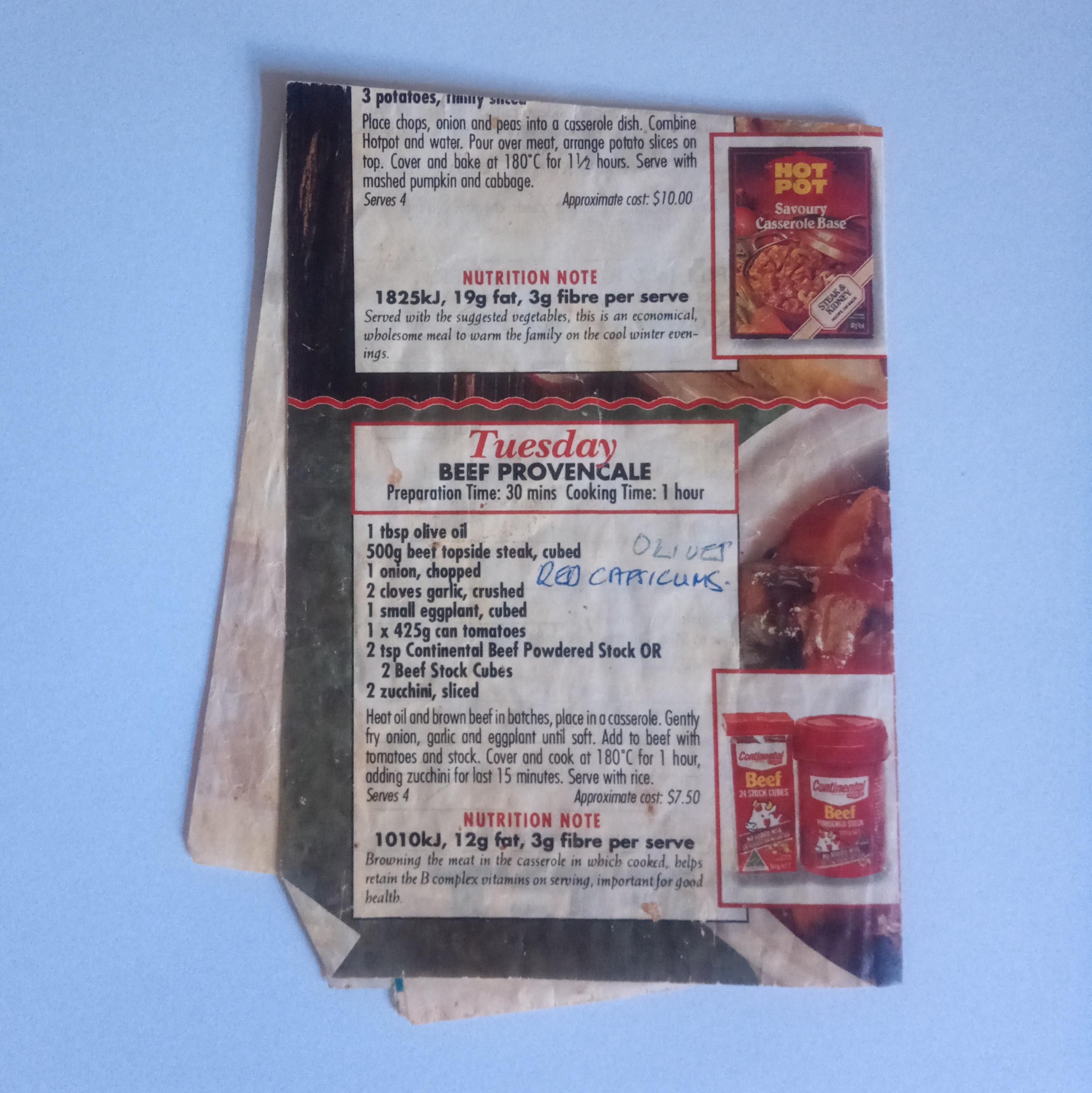
I wasn’t sure of what making 'stew' might entail. Some of the recipes that came up upon a cursory google search did look familiar, but these ones seemed to be leaning a bit soup-ish. I had an idea of what I wanted to make, I had an idea that it was probably classified as a stew, I just wasn’t clear on how it would all come together.
Drawing from Jamie Oliver's Beef Stew, alongside a couple similar recipes, I was able to get an idea of the basic techniques and ingredients I wanted to use. The alcohol used in recipes was sometimes red wine, sometimes dark beer, sometimes left out entirely. Tomato was a popular inclusion but not what I was going for, though it probably would have worked anyway. Sometimes the meat was seared beforehand, sometimes baked. Sometimes the stew was made on the stove, sometimes a slow-cooker, often in the oven. I played around with a few of these options.
Many of the stews I found online and in recipe books were proudly advertised for their shortcuts. For reasons not totally within my understanding, this was something I was hoping to avoid. I wanted to do my stew right. I wanted to do it slow.
Benjamin DuBow's The Sabbath Stew (highly recommended reading) gave me my first clue as to why slowness was asserting itself as an integral ingredient of my first stew. In the essay, DuBow traces the history and evolution of Cholent, a traditional Jewish slow-simmering stew made for/before Shabbat, and its unique role within European Jewish culture. In the essay, DuBow describes the stew as having a "temporal quality." Finding its birth in a centuries-long evolution of Talmudic loopholes and (in a very mundane, but nonetheless powerful manner) ritualistically marking the divide between the working week and the Sabbath, the stew, both historically and daily, carves out a space of its own in time.
I was reminded, of course, of Abraham Joshua Heschel's fantastic work of theology The Sabbath, in which he argues that Judaism has come to centre not around sacred places, but around sacred time. In the book, Heschel describes Jewish ritual as an "architecture of time" which transcends the confines of space through custom and practice. This makes sense in the context of the long history of religious persecution of Jewish communities: holy sites could be taken away at any time, time itself could not. Thus Judaism, over the centuries, came to centre around the "sanctification of time."
The turning of the week into the Sabbath lays at the heart of this sacred time. As Heschel's daughter said in her introduction to The Sabbath: "Preparation for a holy day, my father often said, was as important as the day itself." Religion emerges in the transitions: life and death, night and day, holy time and ordinary time. The Sabbath stew, bubbling with both potential and anticipation, marks the gradient between these times.
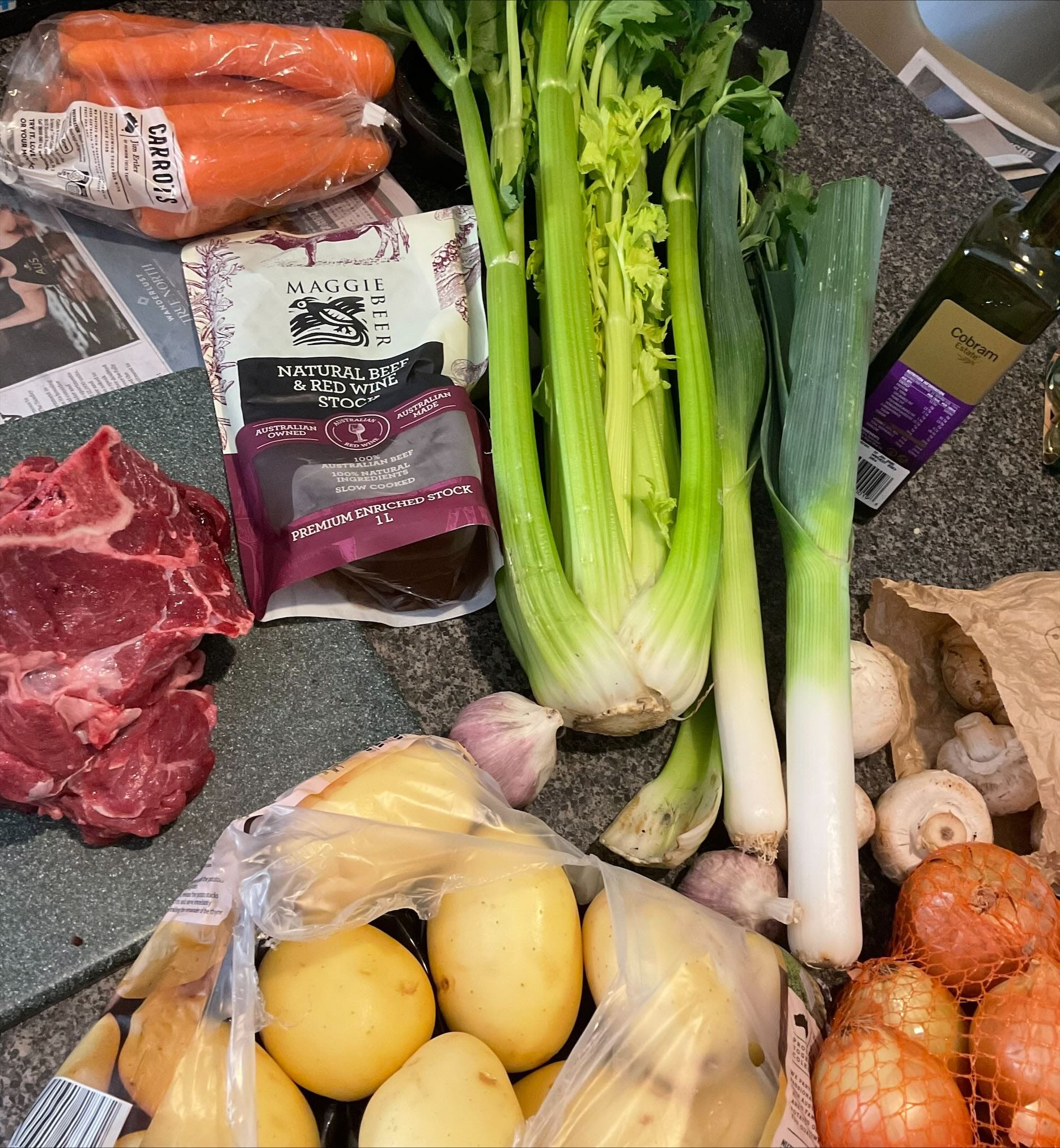
Note: I'm halving the proportions I used. The below feeds at least 5, and will fill a cast iron oven dish, or stove pot. I made two; one went in the oven, one on the stove. It was more than enough for dinner for my grandparents and I, a couple serves in a takeaway container for my brother, and a week's worth of lunches.
Beef stew
1kg "soup bones"
Salt all over. Flour lightly.
Braze (fry until browned on outside) on medium in a pan/pot.
Put in a side dish.
4-5 onions, several cloves of garlic
Pan fry on medium with oil until caramelised (clear and sweet smelling).
(Depending on the surface area of the pan/pot, it may be best to place vegetables that are finished cooking in a side dish, until everything is prepared, and add back in later.)
250g mushrooms
Cook in butter until soft.
1 leek
Add to mushrooms.
Close lid.
Cook until soft (5 mins).
2 carrots, 2 celery sticks
Fry until softened (another 5 mins).
Woody herbs: rosemary, thyme, bale, parsley, a few cloves
Add to mix.
A couple tablespoons of flour
Add to pan slowly, stir in.
This should soak up the oil and thicken the mixture without becoming dry.
500ml beef broth + red wine
Put all ingredients remaining (or put to the side) into the slow cooking dish.
Meat should be totally submerged in the stock/water/wine.
If not enough, use extra water to cover.
Dutch Oven/ Casserole dish in oven (150 degrees Celsius, just leave it to cook), or pot on stove (medium heat, stir often), or automatic slow cooker
Lid on.
4-5h cook time. For stove cooked the lid should be off for last hour.
Meat should be falling of the bone without completely falling apart.
Serve with:
Mashed potato: boil, peel, mash. Mix in a dash of milk and a tablespoon of butter. Salt.
Beer! I don't drink really and don't have much of an idea how to pick out something good, so I went with a non-alcoholic beer substitute. And then, in true stewer style, I watered it down. Was this disgusting? Yes. Did I regret this choice immensely? Absolutely. Was it nonetheless necessary in establishing the karmic balance of the meal? Arguably yeah.
A few slices of bread. Liberal coat of butter.
For dessert, a single sliced orange. #noscurvy
The above is part one of two.
If I'd known that Substack wasn’t going to allow me to post the entire thing I probably could have put it out months ago. I'm not too pressed though. After all, stewing cannot be rushed. You have to sit in the flavour, let it slowly meld together. It takes time, lots of it; trust in the process; patience. And, if you’re unable to part with the idea that time spent on slow things, boring things, ‘unproductive’ things, is time wasted — this process may prove torturous.
I hope that this ending doesn't land too abruptly. Keep an eye out for the second installment, and subscribe if you haven’t already to receive it direct to your inbox.